
I didn’t have my uniform, my gi, for my first lesson, nor for my second one. I had to wait until my third lesson, when I joined the regular class, to receive my own uniform.
I was early for my second lesson so I had to sit on a stool and wait near the front door. While I was waiting, I couldn’t help but turn my head each time the door opened to see a man — it was almost all men — enter the school, walk past me carrying a duffle bag, and disappear behind another door at the back of the school.
Each student would emerge a few minutes later wearing his gi and belt wrapped around his waist, a sight that, to me, felt like watching Superman come out of his phone booth.
I was enthralled.
I wanted to be able to be like them, I wanted to walk behind that door and emerge a changed person, and I wanted my very own “super suit.”
The day I came in for my first group class, my teacher handed me a crisp, clean white uniform and told me to go change into it for class.
It was really happening.
If I could have exploded from sheer excitement, I wouldn’t be here right now.
Since I’ve been a teacher, I have routinely observed parents see their child unable to contain themselves in their first class and not quite grasp how overwhelming the pure excitement can be for a child.
I know it.
I still remember the feeling. I can feel it as I write.
Your child isn’t being difficult. They are literally vibrating with an energy that can barely be contained.
In the locker room, I hurried into my gi pants, tossed on my gi jacket, and proceeded to tie the most convoluted belt knot in the history of the school.
Then, I too emerged from that same door, like a white knight, though I’m sure I looked like a little kid in his pajamas to everyone else.
Which I was.
I went to St. Joseph’s Catholic elementary school, so I was used to wearing a uniform each day for class, but I dreaded changing for school at the weekend’s end.
Donning my martial arts uniform before each class was like preparing to step into a different, fascinating world, one where I left my mundane, daily existence behind and readied myself for some new adventure and danger on the training floor.
One of the perennial pieces of advice I give my students as they walk in the door, put on their gi, and step on the mat, is this — leave every care, every worry, and every stress behind during class, and get ready for a good time on the mat.
When students seem like they can’t let it go I tell them, “all those worries will be there after class ends, so stop worrying about your worries.”
That usually gets them in the right mindset.
This Ritual Is Ancient
What I was experiencing in that locker room — the transformation that happens when you change your clothes with intention — is not a modern invention. It is one of the oldest rituals in human history.
Jigoro Kano, the founder of Judo and the man who formalized the gi and belt system in the late 1800s, designed the uniform deliberately. He wanted to strip away the markers of social class — the expensive silks, the family crests, the rank insignia of Japanese society — so that every student stepped onto the mat as an equal. The uniform didn’t just cover the body. It erased the outside world. What you were before you walked through the door didn’t matter. What mattered was what you did on the mat.
Before Kano, samurai had formal protocols for donning their armor — not just practical preparation, but ritual preparation. The act of putting on each piece was meditative, deliberate, a signal to the mind that a different mode of being was required. Buddhist monks have worn robes as a practice of identity for over 2,500 years — the robe is not just clothing, it is a declaration: I am here, now, for this purpose. Medieval knights were ceremonially invested in their armor before battle, the donning of each piece accompanied by prayer and intention.
Every warrior tradition across every culture found the same thing: changing what you wear changes who you are in that moment. Not metaphorically. Actually.
What the Research Says About Putting On a Uniform
Science now has a name for what I felt in that locker room: enclothed cognition.
In 2012, researchers Hajo Adam and Adam Galinsky published a landmark study showing that the clothes you wear don’t just change how others see you — they change how your brain performs. In their most famous experiment, people who wore a white lab coat made significantly fewer errors on attention tasks than those who didn’t. Same coat, different result depending on whether they were told it was a doctor’s coat or a painter’s coat. The symbolic meaning of the clothing changed how the mind functioned.
Put on a uniform associated with focus, discipline, and serious work — and your brain starts operating as if you are the kind of person who is focused, disciplined, and serious. The costume precedes the character.
Amy Cuddy’s research on embodied cognition — which we touched on in the Attention post — points in the same direction: the body is not a passive vehicle for the mind. It is an active participant in shaping mental and emotional state. What you wear is part of that. The gi changes your posture. It changes how you carry yourself. It signals to every system in your body that you are somewhere specific, for something specific, and that normal rules don’t apply right now.
That’s not a small thing. That’s the entire point.
Forty Years of Watching the Uniform Work
I have watched this happen thousands of times. A kid walks in the door scattered, grumpy, wound up from school, at war with a sibling. They disappear into the locker room. Three minutes later they walk out in their gi, and something has shifted. Not always completely. Not always immediately. But the uniform starts the process.
It’s why I take the gi seriously. It’s why I teach students how to tie their belt correctly. It’s why the uniform has to be clean and neat. These aren’t arbitrary rules. They’re the ritual — the same ritual that warriors have used for thousands of years to make the transition from ordinary life into something more intentional.
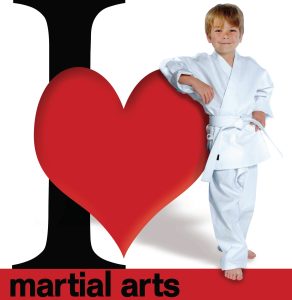
This powerful, affirming ritual of changing my clothing to change my mind and emotional state is another reason why I love martial arts — and so should you.