
 The belt test itself is only half the story. What comes after — the graduation ceremony — is where the transformation is made official.
After the sparring was over, after every candidate had been put through every phase of the test, we lined up just as we had at the beginning. But this time we knelt down in seiza — on our knees, hands resting on our thighs, sitting tall — and waited in silence for our teachers to decide who had passed and who had not.
What followed seemed to take hours.
The door opened. The black belt instructors re-entered the mat, each carrying a stack of new belts, folded and crisp. They walked in front of each of us. In front of those who passed, they placed a new belt. Those who did not pass — they simply walked by in silence. No announcement. No explanation. Just the presence or absence of that folded belt on the mat in front of you.
When all the belts had been placed, my teacher spoke: “If you have a belt in front of you, take off your old belt, fold it like the new one, and place it to the left.”
I never wanted to be one of the people with no belt in front of them. I saw the faces of those who didn’t pass. I made a private vow, right there on my knees, that it would never be me. And I worked every class after that to make sure it wasn’t.
The Meaning in the Arrangement
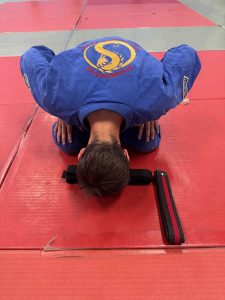
The two belts — old and new — were placed horizontally and vertically on the mat in front of me, forming the letter L.
We were told not to touch the new belt. Anyone who touched it before the proper moment would fail the test on the spot.
Then the meaning was explained.
The old belt was placed to the left because in America, we read time from left to right. The newest students line up at the left of the class. The most advanced line up at the right. The left is the past. My white belt — everything I had learned, every class I had attended, every rep I had thrown while wearing it — belonged to the past now. But I was told not to discard those experiences. I was to carry them forward. The white belt and everything in it was still mine.
The new belt in front of me was the present. The rank I had earned that night, for all the work I had put in while I was a white belt.
To the right — nothing. The right was the future. A future that, I was told, hopefully included a black belt.
When I heard that, something hardened inside me. There was never any doubt after that moment. Why else was I training? I wasn’t here to become an orange belt. I was here to earn a black belt. That was my focus, and that moment of silence on my knees cemented it.
I was also told that if you imagine adding a black belt to the right of the arrangement — standing vertically — the three belts together form the letter U. White, yellow, black. The cup. The cup of knowledge — containing all the experience, skill, and wisdom earned through a lifetime of training. I was determined to fill that cup.
And the L formed by the white and yellow belt? It stood for longevity. The teacher’s hope for every student. Not just that they pass the test, but that they stay. That they persist. That they show up for years and decades, through the plateaus and the setbacks, through the easy seasons and the hard ones, until the cup is full.
The Choice Nobody Expects
Before we could touch our new belts we were given a choice I was not prepared to hear.
The question was: “The promotion board has decided to advance you. However, if you feel that you did not earn or deserve this belt, now is the time to decline it.”
Decline the new belt?
I have never forgotten that moment. In a world where ranks and credentials are handed out, inflated, and chased for the wrong reasons, that single question cuts through all of it. It places the meaning of the belt exactly where it belongs — not with the teachers, not with the board, but with the student kneeling on the mat.
Over the years, I have seen a handful of people decline their belt. Not many. But enough that the possibility is real and not merely ceremonial. Every one of those individuals knew they did not give tehir best, so they chose to go back, work harder, and return when they felt they had truly earned it. They wanted the belt to mean something so badly that they were willing to wait — to hold themselves to a standard even the promotion board was prepared to waive.
I have the utmost respect for those people. In some ways, they understand the belt better than anyone who accepted one easily. They refused to settle. They refused to let the ceremony be a formality. They made the promotion board’s decision secondary to their own honest assessment of where they stood.
That kind of integrity — especially in a moment of public celebration, when every instinct says take the belt and stand up — is one of the rarest things I have ever witnessed on a training floor.
Head Before Hands
Now came the answer to the question everyone was holding: why can’t we touch the belt?
Before we touched the new belt with our hands, we were to touch it with our foreheads.
This was not bowing to the belt. It was a declaration — symbolic and precise — that knowledge reaches the mind before it reaches the hands. Understanding comes before skill. You must first comprehend what you are learning before your hands and feet can execute it with any real depth.
We touched our foreheads to the belt. Knowledge to the head.
Then we picked it up with our hands. Skill to the hands and feet — earned through diligent, repeated practice, long after the understanding arrived.
And then — finally — we tied on the new belt and rose from seiza.
That rising was not incidental. You don’t just stand up. You rise as a different person than the one who knelt down. Everything about that moment felt different. I was no longer a white belt. I was a yellow belt. Something had changed — not just the color around my waist, but something inside it.
That first belt graduation is something I will never forget.
The Kick
I thought we were finished.
We were not.
We were all told to stand in our horse stances, hands on our hips. I had no idea what was coming. I thought we were just bowing out, like every class.
It is a tradition in American Kenpo that when you earn a new belt, you receive a ceremonial kick to the gut.
That’s right. Standing in horse stance, we were each kicked in the stomach. Mine was just a tap — I was new, and it was my first test. But as I watched the higher belts, I understood: as the colors got darker, the kicks got harder. And now I understood why all those black belts had come out of the woodwork. Our main teacher kicked first. Then every black belt at the test got a turn. Multiple kicks. From every black belt in the room.
My teacher explained it: his teacher had told him that earning a new belt is like being reborn. And with birth comes pain. The kick symbolically launches you upstairs to the next level.
I also looked forward, from that moment on, to the day I would be one of those black belts on the other side of it.
The Ancient Roots of Graduation Ceremony
Every culture in recorded history has marked the transition to a new status with ceremony. The earliest graduation ceremonies were solemn affairs, emphasizing the importance of knowledge, scholarship, and the pursuit of truth — marking the student’s entry into a community of scholars. The caps, hoods, and gowns worn at academic ceremonies trace their symbolism directly to medieval monastic traditions, representing scholarly devotion and the orderly evolution of knowledge.
The laurel wreath in Italian graduations symbolizes victory, echoing ancient Roman and Greek practices. The sword presented in Finnish doctoral ceremonies represents the defense of knowledge and truth. The tassel moved from right to left marks the transition from candidate to graduate.
What my teacher built into that belt graduation ceremony was the same thing — layered, deliberate symbolism encoding the meaning of the transition into physical objects and physical actions. The L. The U. The forehead before the hands. The rising from seiza. These are not arbitrary. They are a language. And like all the best ritual languages, they work on you whether you fully understand them or not — and work even more powerfully once you do.
On Hazing — An Honest Reckoning
The kick is, technically, a hazing ritual. And hazing is something I think about carefully and honestly.
It has gotten a terrible reputation — deservedly so in many cases. College fraternities have abused initiation rituals to the point of deaths. Military units have taken physical challenges well past any reasonable threshold. These are not abstractions. People have been hurt and killed in the name of tradition.
And yet — the research on why hazing persists is genuinely interesting, and worth sitting with rather than dismissing. Studies have demonstrated that individuals who experience painful events collectively display stronger bonds and greater generosity to fellow group members than those who perform comparable painless tasks. Research convincingly shows that when people experience difficulty, discomfort, or suffering to attain something — such as acceptance into an exclusive group — they tend to value the group more afterwards than if they encountered little or no difficulty.
Everyone I trained with looked forward to getting kicked. It was an honor — a signal that you were tough enough, that you had whatever it took, that you had survived something and were stronger for it. The students who went through it in my school were uniformly proud of it. Some, when I stopped the practice, asked if they could just do it to themselves.
I stopped doing it anyway. The optics were too difficult. I could not spend every class teaching students not to be aggressive or offensive toward others, and then stage something that looked — to any outside observer — borderline abusive, regardless of the spirit in which it was intended. The contradiction was too visible. I couldn’t defend it in the lobby.
But I remain genuinely ambivalent. Having been through the kick, and through other physical and psychological challenges in my training — including things I won’t describe here — I believe they did something to me that I could not have gotten any other way. I cannot say with certainty that I would do them again. I can say that having done them, I am different than I would have been without them.
There is also, I should acknowledge, an element of survivorship bias in all of this. The people who loved the kick are the ones who stayed. I have often wondered about the ones who left — whether that moment, or something like it, was part of why they went. Would they have stayed if the tradition had been different? Could they have become black belts in a school where the ceremony was gentler? I don’t know. And that uncertainty is part of why I made the decision I made.
The graduation ceremony — the seiza, the silence, the placement of the belts, the symbolism of L and U, the forehead before the hands, the rising as a new person — all of that I kept, and all of that I still teach. The kick I set aside. Not because it had no value, but because the value wasn’t worth the cost of the confusion it created.
That honesty — about what works, what doesn’t, what to preserve and what to let go — is itself something I love about martial arts. The tradition is alive. It changes with the people who carry it. And the willingness to question even the things you cherish most is, in its own way, the highest form of respect for them.
That, and everything else in that graduation ceremony, is another reason I love martial arts. And why you should too.